
One of the requirements in the courses in the Applied Digital Learning program is to complete a reflection and self-assessment. You can view mine below for my first two courses.
Tag: growth mindset
-
Dr. Harapnuik (2020) suggests that those learners that have a growth mindset will take feedback and criticism as a challenge. This challenge presents a chance to grow and progress in mastery of a concept. These challenges are opportunities to get closer to understanding. We should also embrace the “power of yet” (Dweck 2007). With feedforward, we place the value on that challenge, and not success. The focus should also be placed on finding a sense of purpose (Harapnuik 2020).
In my experiences in the Applied Digital Learning master’s program, I have had many opportunities to give and receive feedforward. This is a foundational part of the entire program. Collaboration is strongly encouraged in every aspect of each course. Was all the criticism I gave or received feedforward? I am still working on my true understanding of feedforward. My skepticism comes from my own battle with my growth mindset.
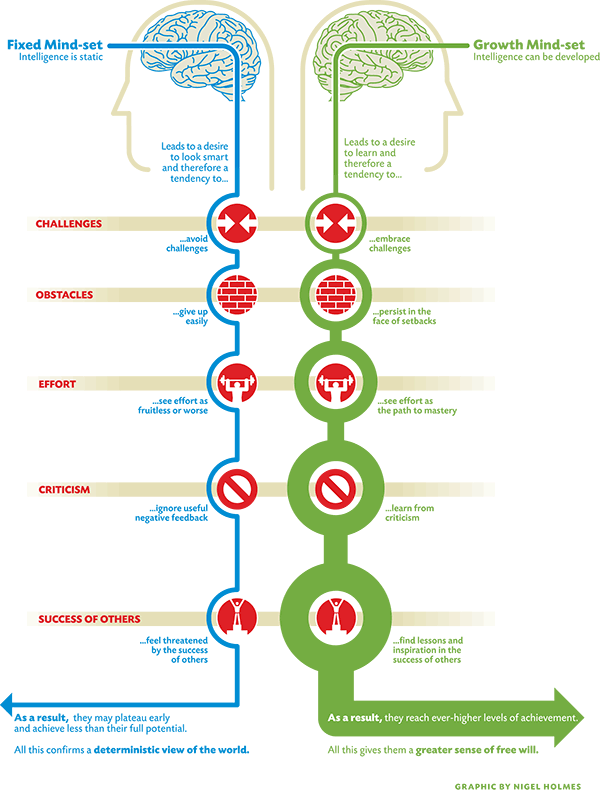
While I did not ignore the suggestions of my peers, I was fearful of appearing to not understand the topic. In other words, I did not want to look dumb. This is just my own lack of confidence. I am aware that I am not dumb. This is an issue that I need to work on. It has always been hard for me to put myself out there. By sharing my work, I am vulnerable. This is a challenge that I will continue to tackle. I hope I can gain self-confidence. This vulnerability is good. I am developing skills I have always lacked, namely those that would make me a better leader.
References
Dweck, C. S. (2007). Mindset: The new psychology of success (Updated Edition). Ballantine Books.
Harapnuik, D. (2020, April 30). Feedback vs. feedforward. https://www.Harapnuik.Org/. https://www.harapnuik.org/?p=8273
-
“People don’t buy what you do; they buy why you do it. And what you do simply proves what you believe”
― Simon Sinek, Start with Why: How Great Leaders Inspire Everyone to Take ActionWhen someone asks me what I do for a living, the answer is automatic. I am a math teacher. The next question is always what subject I teach. I teach Algebra 1 and Geometry. This usually elicits the response of “oh bless you!” or “Geometry was my favorite math class” or “Algebra was the worst!” The “how” of my profession is not ever addressed in these conversations because quite frankly that is not that interesting for those who are not educators. That brings me to the fact that those who are curious don’t typically ask why I teach. Since my time as an undergraduate student or the few times I was seeking new employment, I have not given my “why” a lot of thought.
Why did I choose this profession? I was told by a few of my professors when I was pursuing an engineering degree, that I had a talent for tutoring my peers. I was surprised they noticed. My peers provided some feedback to provoke those critiques from my teachers. It planted a seed. It took until my first Chemical Engineering course for me to see the writing on the wall. I was a wife and mother of 3 small children at the time. My peers were studying for hours. These were hours I did not have. I changed paths at this time. I loved math and science. I love learning. I love collaborating with my peers. Teaching seemed a natural switch of majors. In that switch, I found I loved witnessing children learn and grow in their knowledge. It is a privilege to be able to do that. And I am good at connecting with my learners.
This program is helping me become an even better educator. It is also teaching me that my true role is something new and uncomfortable. I want to guide and facilitate learning. I want to share in my students’ successes. My students should take control and work with me to do this. I feel that the ADL program and the COVA approach let me get a point of view of what I want my own students to experience within my classroom.
Challenges have been many during my first 2 courses in the program. Having that ownership and voice through authentic learning experiences have proven to be so impactful. The struggles with how to approach the assignments have been stressful, but with the help of my peers through our learning communities and a lot of reflection time, I have found that I can tackle anything. These experiences have also pushed me out of my comfort zone. I am finding that I have more confidence. I can see myself as a leader. My opinions have value and others will listen to them. This is huge for me. I have always been a great team player, but never the leader. I want to be a leader. I want to be able to represent my “why.” I think people will be inspired by it. And together we can create change.
The best way for me to represent my “why” at this time in my ADL journey is my ePortfolio. I am excited to share my work for others to see and give me feedforward. I know that by allowing this I can only become better and my vision can have a greater effect on my community. My intentions are to continue to utilize the platform that my ePortfolio gives me. I want to grow as a writer, something I never thought I would call myself. My classmates have provided so many new ideas that I want to implement in my own classrooms. I hope to reflect on these trials through my blog.
The most valuable lesson I have learned is that I made the right choice for myself. While I have toyed with the idea of a master’s degree for years now, this was the time I was supposed to get it and this was the program. I will strive to make changes that will go beyond my immediate community. I am optimistic that my future as an educator will be much brighter with my decision to return to school.
ReferencesTEDx Talks. (2009, September 28). Start with why — how great leaders inspire action | Simon Sinek | TEDxPugetSound [Video]. YouTube. https://www.youtube.com/watch?v=u4ZoJKF_VuA&feature=youtu.be
-

Photo by Monstera on Pexels.com Growth mindset has been a topic that I have learned about in many Professional Development opportunities in my short time in education. As I read Mindset (Dweck, 2016), I was reminded how a lot of times I can embrace the fixed mindset. I have given up on many attempts at hobbies, like sewing and playing the piano. I felt I was not good enough and did have the time to devote to learning about making a quilt or playing Canon in D by Pachelbel. Ironic for someone who preaches about Growth Mindset on an almost daily basis to her students. I did answer the questions posed by Dr. Dweck as one with a growth mindset. Now, why would I give up so easily when I believe that I am not incapable of learning new things?
I thought back to my childhood and the many extracurricular activities I tried and gave up. There was gymnastics, t-ball, dance, the piano, basketball and the drill team. The last two were school-sponsored opportunities. I cannot pinpoint a particular reason as to why none of these ever became something I did beyond trying out or attempting for a few months. I was not told I was not good at it, but also I do not remember anyone else encouraging me to keep it up. My parents never forced me to do any of these types of activities. I believe if I chose to stick it out, they would have supported me. I do remember the feeling I was not good enough or talented enough to keep it up. Other kids were better than me and it came more naturally to them. The praise I heard from my parents, family members, teachers, and adults in mentoring roles in my life was not about effort or perseverance, It was about how well they perceived I could be. Was this something I hold against them for not helping me overcome my insecurities? Absolutely not! They were telling me what they believed was encouraging and supportive. I am sure as a parent I have not done well for my own children in developing a growth mindset.
“In the fixed mindset, everything is about the outcome. If you fail—or if you’re not the best—it’s all been wasted. The growth mindset allows people to value what they’re doing regardless of the outcome . They’re tackling problems, charting new courses, working on important issues. Maybe they haven’t found the cure for cancer, but the search was deeply meaningful.”
― Carol S. Dweck, Mindset: The New Psychology of SuccessI try to be a cheerleader in my classroom as well as at home. I want all my students to know that I believe in them and their abilities. My learners are all unique and learn differently. I love the power of “yet.” It reminds us that we don’t have a set schedule on how we have to learn. My goal is always to find the best way for each of my learners to be supported and encouraged. I want to help them find their motivation and see the joy of mastering a new topic. Those lightbulb moments my students have during class or tutoring are priceless and bring me a lot of gratitude when I get to experience them. I strive to communicate my beliefs about how learning is not something that is instant in most cases. It takes practice and application. Most will experience failures and those need to be chances for us all to learn from. Mistakes are opportunities for growth and second chances. I find many of my learners compare themselves to their peers. We all have done this at one time or another. One student grasps a concept after one example and is able to speed through the practice. Another learner struggles, even after multiple examples and reteach opportunities. They are left feeling defeated and that it is too hard. Why should they bother trying to figure it out? I have to use this very situation to help this learner deal with the failure and see it as a benefit for their learning.
Failure is too often tied to a numerical grade or percentage. This is where a chance to change my students’ mindsets comes in. One focus this coming school year will be to cut the ties of failure to a particular grade. My philosophy on giving multiple attempts for assignments and assessments is shifting as I read about effort, determination, and mindset. As educators, we often use a grade to penalize or punish a behavior (i.e. 20 point penalty for turning in late). What effect does this have on the learner’s motivation to attempt that assessment or assignment again? I see time and time again my students will take an additional attempt for granted and rush through it. They are just wanting to “pass”. Their response is “just give me the 70, miss.” I am not happy with mediocre work and I want them to not be happy with it either. How do I help them see the benefit of going back to relearn a concept that they are struggling with to be able to successfully retake a quiz or test? I think my first step is to not punish them by giving them only partial credit. I will assess their mastery the same on all attempts. I hope to shift the thinking of failure as a bad thing to look at the mistake as not knowing or getting a concept just “yet.”
References
Alumni, S. (2014, October 9). Developing a Growth Mindset with Carol Dweck [Video]. YouTube. https://www.youtube.com/watch?v=hiiEeMN7vbQ&feature=youtu.be
Dweck, C. S. (2007). Mindset: The New Psychology of Success (Updated Edition). Ballantine Books.
TEDx Talks. (2012, November 18). The Power of belief — mindset and success | Eduardo Briceno | TEDxManhattanBeach [Video]. YouTube. https://www.youtube.com/watch?v=pN34FNbOKXc&feature=youtu.be
-
“no matter what your ability is, effort is what ignites that ability and turns it into accomplishment.”
Carol S. Dweck, Mindset: The New Psychology Of SuccessOne would think that it is easy for an educator to adopt a growth mindset. But as I read through Carol Dweck’s article titled Carol Dweck revisits the ‘growth mindset,’ I reflected on my mindset. While I claim to have a growth mindset, I also have some traits of the “false growth mindset” described in the article. I was led to believe in the professional developments I have attended in the past that it was the ideal thing for our learners to be successful. I have tried (and failed) to encourage my students to realize their ability to conquer math. I would talk “the talk”, but have not really walked “the walk.” Self-doubt and lack of confidence in teenagers are difficult things to overcome. I would find myself walking away from a student that would refuse my support or help. I need to practice what I preach and not let them give up so easily. I know that they are all capable of being successful in my math class. It is not realistic to expect our students and even ourselves to have a growth mindset every minute of every day. We need to learn strategies to address those moments when that fixed mindset creeps back.
One of the most important goals that I hope to accomplish with the help of technology is to provide my learners with timely and appropriate feedback. With the help of the digital medium, I will be able to monitor their progress in real-time as they work through online practice and assessments. It can help me make decisions regarding necessary interventions or even enrichment opportunities. This will also give me a chance to help my learners find their growth mindset. The online practice also makes it easier and more convenient for multiple attempts to complete and demonstrate mastery of concepts presented in my class. How do I help them see the benefit of their attempts after a previous failure? This is a question I am going to have to think about A LOT. My experiences with allowing retakes on assessments and redoing assignments have not been ideal. The students just are in it to “pass.”
I want to find a way to convince them that failing is not a bad thing. It is something we cannot shelter them from. This is why having a growth mindset is so important for their success. I need to show them how their efforts and the different strategies will lead them to understand and achieve anything they put their mind to. Hard work is just part of it. Failure and perseverance are just as important.
Reference
Dweck, C. S. (2007). Mindset: The new psychology of success (Updated Edition). Ballantine Books.
-
Words have a lasting impact. We often hear the phrase, “Actions speak louder than words.” Body language and tone of voice are just as impactful as words.
By creating a visual representation of my innovation proposal, I hope to convey the importance of changing our learning approach in our Algebra 1 classrooms. The goal is for my audience, my administrators, my department chair, and the school community, to realize my sincere intentions of providing the most beneficial classroom environment for our learners. The opportunity that a flipped classroom will afford the students to find their voice and ownership.
The point of view that I must take with my media plea is one of our community. Here are some questions I need to answer:
- Will the benefits go beyond our Algebra I classrooms?
- How can this model’s employment inspire educators in other subject and content areas?
- How will I support those joining in my vision?
- Where do my colleagues stand in their comfort level of technology in the classroom?
- What does the teacher’s role look like? What does the student’s role look like?
- How do we ensure the success of a blended learning model?
- Do we need to utilize other models and create a hybrid model of our own?
- What support do I need to implement and ensure the success of my innovation project?
I think my words and research will help me do this, but I have to convince my audience that I truly BELIEVE it is a necessary change for ultimately the whole of our school community. This is the most important piece of my proposal, my belief. With that mindset, I do not see how we can fail!

Photo by Andrea Piacquadio on Pexels.com References
Crucial Learning. (2015, January 5). How to change people who don’t want to change | The Behavioral Science Guys [Video]. YouTube. https://www.youtube.com/watch?v=9ACi-D5DI6A&feature=youtu.be
Words, P. O. (2010, February 23). The power of words [Video]. YouTube. https://www.youtube.com/watch?v=Hzgzim5m7oU&feature=youtu.be
 Valary's Vision of a Modern Secondary Mathematics Classroom