I began this year looking for better options for open lines of communication outside of the classroom for my Geometry learners. Remind does not offer the features I need to go in the direction I hope to guide my students in. In brainstorming with my campus Instructional Technology Specialist, he suggested Microsoft Teams. All the students in our district have access to Microsoft 365 Suite. It has integrated features to allow a teacher to create and monitor a class group. There are also ways to make assignments, calendars with deadlines, and other options that I utilize in our district LMS of choice.
I was looking for a way to encourage interaction and collaboration between the learners and even myself. I want to foster opportunities for peer support when they find themselves struggling. We can share files, pictures, and links. I am also looking at encouraging video responses, as well as text responses. I am not looking to do any type of formal assessment in this medium. I merely want to open a means of dialogue that will expose the learners to other resources they have when struggling through their learning. I am cautiously optimistic and I look forward to building on these ideas of collaboration that can be meaningful and useful in the future for all of us.
When I have shared the experiences of creating my ePortfolio with my learners, the comments and reactions are comical. One young man asked me, “Why do you have to have a Blog? Writing about math? Gross!” My response was laughter because this young man was partly kidding. I explained a little bit about what I am trying to accomplish. I spared them the details that I could have provided about CSLE+COVA (Harapnuik et al., 2018). I will admit to getting a little excited when I have the opportunity to talk about the ADL program. If I had the chance, I likely would have not been able to get to the learning target for that day’s lesson. I made my students aware that they are part of my evidence and a direct reflection on my mastery of the concepts I am tasked to master throughout the ADL Program. I saw a few smiles and heard a few sarcastic responses of “Good luck with that, Mrs. Patterson!” All of these are really said in jest. I have great learners that I teach me something on an almost daily basis. I am fortunate to get to help them realize their full potential as learners.
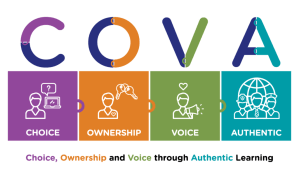
CSLE+COVA: Creating Significant Learning Environments to offer Choice, Ownership, and Voice through Authentic Learning
While my classroom and the learning that occurs there is a piece of my ADL puzzle, one of the other pieces is my ePortfolio. Through my research and development of my Innovation Project and further exploration of the power of one’s Mindset, I have already experienced measurable progress with most of my learners. The response from many learners is the success they find with Flipped Classroom hybrid model I have adopted. Blended learning is defined as the use of online resources, electronic media, and face-to-face instruction for students’ means of learning. Under the umbrella of blended learning, the flipped classroom is a strategy that has the learners watch a curated or instructor-created instructional video at home. This allows for time in the classroom to be utilized for group discussions or activities or the practice that would have been assigned in a traditional classroom (Horn et al., 2015). My team’s approach is a version of this due to the demographic of learners that we have in our classrooms. We have planned for all learning to happen in a class period with teacher support. With this adjustment to the Flipped Classroom model, I am afforded precious time in a class period to help individuals or a small group. This is a teacher’s dream.
During this second term of my coursework, as I focused on creating my ePortfolio, I found the time to continue to ponder and develop some strategies and approaches to try with my learners. With all that I have learned about creating significant learning environments that give my students choice, ownership, and voice through authentic learning, one can only reflect on her practices (Harapnuik et al., 2018). Some ideas have been in the back of my mind for several weeks, but I made some realizations that I posted about in my Blog. Engagement and collaboration, two ongoing challenges, are addressed.
As we enter into the second grading period of the school year and I begin my next course, I will remain vigilant in my reflecting and analyzing the progress in my classroom. It is imperative for all involved to stay focused on the goal and to be flexible in our approach when seeking to attain it. I must also keep lines of communication open with my Learning Communities. It is through these contributions to my learning and that of others that will result in reaching our full potential as learners. My ePortfolio will serve as a manifestation of that journey. We use an ePortfolio because creating something leads us to deeper and more meaningful connections in our learning. Reflection is also an important component of learning (Harapnuik, 2021). I am eager to open more doors in hopes of learning how to be a better educator for my learners.
Giving opportunities for learners to own their learning is vital to mastery. This is prefaced by also allowing for choice in that learning. Over the last 4 months, I have spent countless hours reflecting on how I can create a learning environment that will provide choice and ownership to my own students.
Choice and ownership look different in my classroom than in others. This is partly due to my responsibility to prepare my learners for a required state test. My focus is on giving my learners autonomy and choice. This has been a struggle these first weeks of school. Even with clear deadlines for assessments, my learners struggled to find the motivation to fulling immerses themselves in the learning. The consequences have been the failure to understand the concepts in these first 2 units of study. This may be a reflection of my implementation strategy.
My Innovation Project that I am working on through my graduate program is to see a full implementation of a flipped classroom, a blended learning strategy that is discussed by Horn et al. (2014). The students would watch lesson videos at home and the work that would traditionally be assigned as homework is completed in class with my support available. This would also allow for more time for inventions and extensions with my learners.
With the beginning of a new unit, I shifted my approach. I am structuring class time more purposely in hopes of having them see how to use their time most effectively. As I have reached the end of the first term, most of my learners have made progress and I have witnessed growth.
We still have work to do. And it starts with me. How can I continue to adjust and reflect on my practices for the benefit of my learners? How can I continue to better provide choice, ownership, and voice? Harapnuik et al. (2018) suggest it begins with me, the educator. I have to find a way to relinquish control of their learning. I must remember that I love my students and I care enough about them to let them learn through their struggles. It does no favor to eliminate those hardships.
Growth mindset has been a topic that I have learned about in many Professional Development opportunities in my short time in education. As I read Mindset (Dweck, 2016), I was reminded how a lot of times I can embrace the fixed mindset. I have given up on many attempts at hobbies, like sewing and playing the piano. I felt I was not good enough and did have the time to devote to learning about making a quilt or playing Canon in D by Pachelbel. Ironic for someone who preaches about Growth Mindset on an almost daily basis to her students. I did answer the questions posed by Dr. Dweck as one with a growth mindset. Now, why would I give up so easily when I believe that I am not incapable of learning new things?
I thought back to my childhood and the many extracurricular activities I tried and gave up. There was gymnastics, t-ball, dance, the piano, basketball and the drill team. The last two were school-sponsored opportunities. I cannot pinpoint a particular reason as to why none of these ever became something I did beyond trying out or attempting for a few months. I was not told I was not good at it, but also I do not remember anyone else encouraging me to keep it up. My parents never forced me to do any of these types of activities. I believe if I chose to stick it out, they would have supported me. I do remember the feeling I was not good enough or talented enough to keep it up. Other kids were better than me and it came more naturally to them. The praise I heard from my parents, family members, teachers, and adults in mentoring roles in my life was not about effort or perseverance, It was about how well they perceived I could be. Was this something I hold against them for not helping me overcome my insecurities? Absolutely not! They were telling me what they believed was encouraging and supportive. I am sure as a parent I have not done well for my own children in developing a growth mindset.
“In the fixed mindset, everything is about the outcome. If you fail—or if you’re not the best—it’s all been wasted. The growth mindset allows people to value what they’re doing regardless of the outcome . They’re tackling problems, charting new courses, working on important issues. Maybe they haven’t found the cure for cancer, but the search was deeply meaningful.”
I try to be a cheerleader in my classroom as well as at home. I want all my students to know that I believe in them and their abilities. My learners are all unique and learn differently. I love the power of “yet.” It reminds us that we don’t have a set schedule on how we have to learn. My goal is always to find the best way for each of my learners to be supported and encouraged. I want to help them find their motivation and see the joy of mastering a new topic. Those lightbulb moments my students have during class or tutoring are priceless and bring me a lot of gratitude when I get to experience them. I strive to communicate my beliefs about how learning is not something that is instant in most cases. It takes practice and application. Most will experience failures and those need to be chances for us all to learn from. Mistakes are opportunities for growth and second chances. I find many of my learners compare themselves to their peers. We all have done this at one time or another. One student grasps a concept after one example and is able to speed through the practice. Another learner struggles, even after multiple examples and reteach opportunities. They are left feeling defeated and that it is too hard. Why should they bother trying to figure it out? I have to use this very situation to help this learner deal with the failure and see it as a benefit for their learning.
Failure is too often tied to a numerical grade or percentage. This is where a chance to change my students’ mindsets comes in. One focus this coming school year will be to cut the ties of failure to a particular grade. My philosophy on giving multiple attempts for assignments and assessments is shifting as I read about effort, determination, and mindset. As educators, we often use a grade to penalize or punish a behavior (i.e. 20 point penalty for turning in late). What effect does this have on the learner’s motivation to attempt that assessment or assignment again? I see time and time again my students will take an additional attempt for granted and rush through it. They are just wanting to “pass”. Their response is “just give me the 70, miss.” I am not happy with mediocre work and I want them to not be happy with it either. How do I help them see the benefit of going back to relearn a concept that they are struggling with to be able to successfully retake a quiz or test? I think my first step is to not punish them by giving them only partial credit. I will assess their mastery the same on all attempts. I hope to shift the thinking of failure as a bad thing to look at the mistake as not knowing or getting a concept just “yet.”
One would think that it is easy for an educator to adopt a growth mindset. But as I read through Carol Dweck’s article titled Carol Dweck revisits the ‘growth mindset,’ I reflected on my mindset. While I claim to have a growth mindset, I also have some traits of the “false growth mindset” described in the article. I was led to believe in the professional developments I have attended in the past that it was the ideal thing for our learners to be successful. I have tried (and failed) to encourage my students to realize their ability to conquer math. I would talk “the talk”, but have not really walked “the walk.” Self-doubt and lack of confidence in teenagers are difficult things to overcome. I would find myself walking away from a student that would refuse my support or help. I need to practice what I preach and not let them give up so easily. I know that they are all capable of being successful in my math class. It is not realistic to expect our students and even ourselves to have a growth mindset every minute of every day. We need to learn strategies to address those moments when that fixed mindset creeps back.
One of the most important goals that I hope to accomplish with the help of technology is to provide my learners with timely and appropriate feedback. With the help of the digital medium, I will be able to monitor their progress in real-time as they work through online practice and assessments. It can help me make decisions regarding necessary interventions or even enrichment opportunities. This will also give me a chance to help my learners find their growth mindset. The online practice also makes it easier and more convenient for multiple attempts to complete and demonstrate mastery of concepts presented in my class. How do I help them see the benefit of their attempts after a previous failure? This is a question I am going to have to think about A LOT. My experiences with allowing retakes on assessments and redoing assignments have not been ideal. The students just are in it to “pass.”
I want to find a way to convince them that failing is not a bad thing. It is something we cannot shelter them from. This is why having a growth mindset is so important for their success. I need to show them how their efforts and the different strategies will lead them to understand and achieve anything they put their mind to. Hard work is just part of it. Failure and perseverance are just as important.
Reference
Dweck, C. S. (2007). Mindset: The new psychology of success (Updated Edition). Ballantine Books.



 Valary's Vision of a Modern Secondary Mathematics Classroom