As my online PL course takes shape, I am excited to offer it to my colleagues. I am eager to share what I have learned in the ADL program over the last year. I know that it offers many opportunities and experiences for teachers and their students. That is the most exciting part of this journey. The impact I can have on many more individuals than just my learners.
My professional learning opportunity focuses on Blended Learning and how one can bring those experiences to their classroom. I have a goal to have at least 25% on my school community using a BL model with at least one of their classes in the next three years. With the acquisition of Chromebooks last year, this goal seems more achievable. Every learner on our campus has access to a Chromebook. We need to leverage the technology for our learners’ benefit. I believe that by offering a course that is more than the usual one hour PD session that are a waste of precious time, I can help to encourage and support my colleagues.
With the experiences we were forced into due to the pandemic, technology is still an obstacle for some educators. We have anxiety about all the trial and obstacles we endured during those difficult months with virtual learning. I want to lead my learning community back into the embrace of technology. It can make our jobs as teachers better if we just use it as it was intended, a resource for learning. It is not ever just about the technology. We have to have use it with purpose and meaningful intentions to help our learners. With this training, I think I will make good headway toward supporting and inspiring my school community.
Here is the document that guided me through this next step in my online course, which is planning for the implementation of my Blended Learning PL opportunity.
With the guidance offered from the questions provided from Dr. Bellard, I have a good first draft of my course. I have created a video presentation previewing the beginning modules of my course. It provides context to why I chose the topic and what I hope for my learners to accomplish in their completion of the tasks and activities I have laid out for them.
With the feedforward from my peers, I am able to plan and create the resources and tasks for my course with confidence. The process of design and development will be ongoing, as I continue to learn and grow. Technology allows us the ability to change, rethink, restructure, and omit resources, activities and assessment tools throughout the learning process. It is a wonderful advantage to have. One thing I have grown to understand about myself as an educator is that my biggest asset is my desire and willingness to learn. I look forward to learning as I implement and redesign this course after each successful implementation.
In this my first assignment in Online Course Development (EDLD 5318), I have been tasked to design a course that will be presented to my colleagues. I will address why I have chosen this particular content. I will discuss what learning activities and the outcomes that I hope to see in my learners. Finally, I will look at how we will assess the learning that resulted from the course.
What are your subject, level of instruction, and intended audience?
The course that I am creating is to facilitate a professional learning experience for my colleagues that teach secondary math courses. I plan to create a learning opportunity to guide my colleagues in creating and implementing a blended learning (BL) environment in their classrooms. While this is my initial audience, I aim to offer this training to those outside my content area in the near future with the guidance and assistance of my district specialists. Ultimately, I would love to see this experience become a semi-annual option for educators in my district.
What are the key institutional documents (i.e. syllabus, outline, accreditation standards, etc.) that will influence your design process?
It has become apparent that districts have an obligation to provide reliable access to technology in and out of the classroom. In order to fulfill this commitment, my district applied for a grant through the Emergency Connectiviity Fund (ECF) offered by the Federal Communications Commission. Through the ECF, the FCC has offered over $7 billion dollars in funds for schools and libraries to use in the acquisition of tools and services for remote learning. With the award of these monies, my district procured Chromebooks for every learner. This is an opportunity for my entire community to make necessary changes in our approach to learning for the betterment of our community, youth and adults alike.
While learners will be free to choose the BL approach, I will provide resources and standards at the core of the BL pedagogy. The following resources will provide guidance for learner outcomes throughout their participation in my course: The focus on these standards is due to our obligation to provide meaningful and relevant learning opportunities for the students in our classrooms. By participating in professional development like this one, I feel I am doing my part to help my colleagues grow and develop best practices in the classroom.
Because the research in this area of education is constantly evolving, I anticipate my development of the learning activities and means of assessment for this course will do so too.
Are you using competency-based education (CBE) or outcome-based education (OBE)? Why?
I am using outcome-based education. This approach allows learners to navigate the learning opportunities with fewer restrictions. My goal is to drive my learners to deeper connections with the BL models and how it can result in more growth among their own learners than the traditional lecture-based instructional model. With the use of Learner Outcomes, self-assessment will be easier and more transparent. This will move my role into more of a mentor or coach than a teacher. I intend to learn right alongside my coworkers through this learning journey.
What design approach have you chosen? Why?
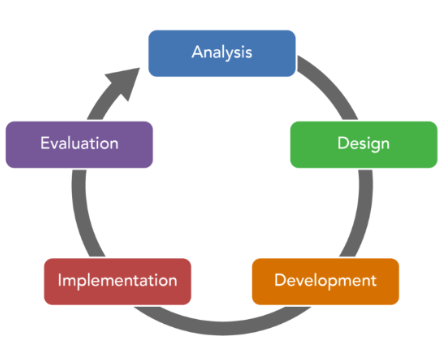
I have chosen to utilize the ADDIE model of instructional design as it fits the progression of the modules that I have created for my course.
A – Analysis: In this first phase of learning, the needs and capabilities of learners is established. A pre-assessment and introduction to BL will be given to the educators.
D – Design: Learners will work with Mentors to begin design of their own BL approach for their learners (Bloom’s Taxonomy)
D – Development: Collaboration and Peer review will aid in the development of learner outcomes within each of the blended learning models to better prepare for the next phase.
I – Implementation: The BL models will be implemented in the classrooms with guidnace and support of mentors, district specialists, campus administration, and myself. Observations will be pivotal for the final evaluation of learning.
E – Evaluate: For the final module, partipcates with reflect and self-assess their learning of the content presented in this PL experience.
How will you balance assessment Of/For/As learning? Are you moving your learners into deeper learning? If not, why not? Who controls the learning?
I will provide opportunities for frequent feedforward from myself and their peers for each participant in my PD. Reflection on the learning will also be important for those deeper connections to be made and reinforced. This will happen through collaboration opportunities and mentor/mentee conferences. The chance for the learners to participate in online discussions will also serve as a formative assessment tool for me to gauge the levels of understanding. Collaboration through group activities, mentorships, and discussions (face2face or online) will foster a student-driven learning environment. Learners must find they have choice, ownership, and voice through authentic learning (COVA).
My learning this term has revolved around determining a plan to evaluate the effectiveness of my innovation plan. I had the opportunity to set into motion a study to eventually improve on my project. With the data procured from this action research, I will be able to change my perspective to see the impact of a flipped classroom from my students’ point of view. While my learners are always my priority in the decisions I make for my classroom practices, I often take a narrow view of their perspective. Taking their point of view reminds me of the influence I can have on their learning and how I can better relate to their struggles they encounter in their learning of the concepts in my class.
With the guidance of my peers, Dawn Short, Ashleigh Carter, Catherine Duplisea, Kristin Winzer and Patrick Rodriguez in our GroupMe chat, I found success in navigating the stages of Action Research. There were always several of my peers that were willing to meet on Zoom or to proof-read a draft of an assignment. They proved exemplary examples and gave meaningful feedforward in regards to my work. I truly appreciate the relationships I have cultivated through this program. I have met people that I will consider friends. It is easy to see myself reaching out in the future for feedforward beyond our ADL journey.
With the end of the spring semester, we have to tackle state testing. It was these obligations professionally that affected my performance in this course. Unfortunately, I did not manage my time very well and I completed discussion posts late. It is something I need to do better at and consider the ability of my peers to respond to my posts in a timely manner. With the collaborative approach that we take in the Applied Digital Learning program, I must always consider my participation and its impact on that of my classmates.
I am reaching the end of my ADL journey. I have just completed my eighth of ten courses. It is hard to imagine that a year ago I was just beginning this experience. I am proud of the growth and progress I have made in these short 11 months. I have come to the conclusion that my quest to be a better learner will not end when I walk the stage in August. This really is just the beginning. I look forward to the last two courses of study in the Applied Digital Learning program. I look forward to continuing my growth as a learner with those in the program and the guidance that we receive from our professors. Dr. Meeuwse provided all the necessary tools and resources to complete the assignments in this course. I also am thankful for the timely and productive feedback from our instructional assistant, Mr. Gann. I look forward to taking the knowledge of action research and applying the plan I have developed to evaluate the impacts of my implementation of a flipped classroom on the learner engagement in my classroom.
As my fourth term in the ADL program comes into a close, I find myself further down the path of growing and progressing as a learner. With each assigned text, video resource, and group discussion, I am validated with my choice of graduate programs. The experiences of choice, ownership and voice through authentic learning is routine and expected. It is how I am afforded the understanding of the content from my two courses.
The opportunity to dive into creating and planning learning for my colleagues was a daunting task. But it was a challenge I was excited to take on. I have spent so many hours in training that I did not fully allow for the mastery of the strategy being presented. This was a chance for me to create a PL that was intentional and purposeful.
As with previous courses, my first line of help and support is my peers. I love that we have a well-established group chat utilizing GroupMe. It is a thread that is active throughout each term. There are learners that are representative of all stages of the program. The people I felt most engaged in the in conversions about 5389 were Dawn Short, Patrick Rodriguez, Ashleigh Carter, Anna Diemecke, Sarah Edler, Shay McDonald, Rebecca Rodgers, Adrianne Ortiz, Kristin Winzer, and LaTammie and James Rawls. With the collaboration of this group, we were able to tackle numerous concerns and questions that came up in our completion of assignments and discussions. Over the term, when we needed more clarification, we met on Zoom to collaborate virtually. Those sessions were a good part of my success in my assignment outcomes. I truly appreciated them sharing their work with me for feedforward and the feedforward I received in return.
I was also able to request feedforward and suggestions from my colleagues in my school community. The Math Dean and our campus ITS representative advised me on my PL implementation and outline. It was through their help that I felt confident in my final plan. I am also planning to reach out to the Secondary Math Curriculum Specialist to see if I can go ahead with assembling a cohort for the fall semester.
Through my feedforward offered to my classmates and discussion threads, the benefit was not solely experienced by my peers. It was helpful in my making connections and deepening my knowledge. By reviewing other plans of PL, I was able to find several ideas that have motivated me to develop and create other opportunities in PL. My experiences will continue to benefit and grow myself and the school community for a long time.
The second course I took gave me the experience of designing a course or unit of study. We, as learning facilitators, create significant learning environments through these tools and resources of design and planning. Again, I looked to my peers to find answers to my questions I had about assignments. As I reflect on my experiences as a learner and how I may contribute to the learning of others, I see that these are what help create a significant learning environment. It is through collaboration and the feedforward, that I find confidence in my own understanding.
The collaborative discussions that are a part of every course truly give us a chance to assess our present levels of mastery in the content from the course. I did not see that until this course. My peers allowed me to gain insights on the assigned readings and video clips from their perspective. I am a person that will have tunnel vision within my own learning. It is through the discussions that my peripheral vision can be restored.
As with my previous courses, the GroupMe chat is an important lifeline for me in this program. Without the support of my peers, I would find myself floundering in my coursework. I did find myself turning to a smaller group than with other courses. We formed our own group message thread. This group consisted of Kelly Skillingberg, Tonya Logan, and Catherine Duplisea. We maintained constant communication throughout the term. These ladies provided me with the best support and advice through this course.
While finding success as a learner is my primary goal, I find that the relationships I am forging with my peers to be a close second. It is their support that provides me with one more means of confidence boosting. I hope that I have been that support for at least one of them. I know that I would not be where I am today without so many of them!
Myself and a friend at our graduation from Plano Senior High School, Plano, TX, in May of 1996
I graduated from high school a long time ago. Almost 27 years ago, actually. If you had told me on that day, my graduation, where I am today, I would have called you crazy! I was NOT going to be a teacher, let alone a high school math teacher. But here I am. And I am exactly where I belong.
I call myself a lifelong learner. I am driven to find answers to all the questions in my head. I always liked school when I was a child. Learning came easy to me. Looking back at those experiences in the classroom through the lens of a graduate student in the ADL program, I am not sure I was learning. I was regurgitating the information my teachers “fed” me through their lectures. Learning is so much more than rote memorization of factoids. Learning is taking in experiences and constructing meaning from those experiences with prior knowledge (Kurt, 2021).
With this new view on learning, teacher and learner roles need to be redefined. The teacher no longer just conveys knowledge through lessons, activities, or examples. The teacher should focus on creating significant learning environments to guide learners to learn (Harapnuik et al., 2018). The learners also have a part to play as well. A learner must learn. One cannot force someone else to learn a particular concept or skill. Learning happens within the mind and is a personal experience (Kurt, 2021). Everyone learns, but what we retain and connect to personal experiences are unique.
Upon investigating the Constructivist theory of learning, I found that collaboration and social experiences are pivotal in the learning journey. The new view of learning validated my self-proclaimed love of seeking knowledge. I look for opportunities to discuss and reflect on learning with anyone who will entertain me. As a facilitator of learning, my confidence has grown exponentially. With that confidence, comes my belief that Constructivist practices, in the classroom will lead to learner success. I see validity in both Cognitive and Social Constructivist theories.
While there is the importance of learning collaboratively, there are also other aspects to the Constructivist approach that must be considered. The learner must “construct their own understanding of the world they live in. In this way, the students play central roles in mediating and controlling learning to set their own goals, regulate their own learning process and even assessment”(Theories_Constructivism – KB, 2018). This leads to the teacher letting go of control of that learning. As I reflect on this aspect of my part in the learning experience, I struggle to allow myself to give up that control. The ties that bind me are of the standardized testing kind. Vygotsky’s theories on Scaffolding and the Zone of Proximal Development provide me with the strategies I need to maintain guidance over my learners with just the right amount of independence to lead some to deeper understandings (Theories_Social Constructivism – KB, 2018).
In my research for my Literature Review for my Innovation Project, I came across a study on Productive Failure in a Flipped Classroom. Song and Kapur defined Productive Failure is a learning design that allows learners to “explore[d], discuss[ed], and solve[d] problems related to the new contents first in class even though they might come across failures…” (Song & Kapur, 2017, p. 292). Allowing for struggle with new concepts will allow learners to strengthen their self-efficacy and have greater success in learning. This productive failure also allows the teacher’s role to be more like a coach or mentor. As I allow for failure amongst my students, that will likely be some of the best teaching I will do.
My philosophy of learning is not static; it is very much dynamic. As a learner, I plan to evolve as an educator. I see power and freedom in knowledge. I want to inspire my learners to find that power and privilege in their learning journey. This realization will be enhanced with a shift in their mindset as a mathematician. So many of my learners come to me with a fixed mindset. Boaler reassures us that we can all learn math (2022). That elusive person everyone claims is a “math” person does not exist (Boaler, 2022). While I am bound to teach to a standardized state test, I will strive daily to facilitate meaningful learning opportunities for my learners. My learners will find joy in their education by implementing constructivist ideals, just as I find joy in their successes and failures.
As a little girl, I remember my sister and I lining up our dolls and stuffed animals in rows in front of our art easel. Pretending we were teachers was one of our favorite activities as young girls. Playing make-believe was almost all we would do when we played. We would play store with an old calculator my dad gave us. We would rake the leaves in our front yard in the layout of a “house” with multiple rooms. We imagined them being mansions! Those are memories I cherish. As I read A New Culture of Learning: Cultivating the Imagination for a World of Constant Change, I consider the connection between the imagination and play of a child to the learning that happens beyond childhood. It leads me to wonder also about how I can influence the future generations who will play school, to change the imaginary environment from the “sit and get” to the collaborative experiences of a collective (Thomas & Brown, 2011, pp. 50-54).
As an educator, I know firsthand that our public education system is fatally flawed. Reform is the word one hears in the media, community discussion forums, and teacher workrooms. However, it is more complex than just a few changes or laws that need to be passed. Education needs a revolution (TED, 2010). Our approach to teaching and learning in a schoolhouse needs to be reconstructed. That transformation has to begin within the walls of the classroom. Thomas & Brown challenge the notion of a traditional classroom by stressing the importance of imagination and play through many different learning approaches, including peer-to-peer learning, questioning, and inquiry (2011). By creating significant learning environments, I will allow my learners to experiment and question.
Book image obtained from amazon.com
At the beginning of the school year, I set out to implement my innovation project. Armed with research from my literature review, my team and I aimed to provide a blended learning approach to the curriculum. We developed a plan that modified a Flipped Classroom model that would be best for our learners. Stations are incorporated for further intervention and enrichment opportunities. Learners are given a layout of the lessons with firm deadlines for assessments. The choice in how they tackle the concepts is theirs to make. Learners are given access to lesson videos in and out of the classroom. Different options are available to practice the concepts, including low and high-tech choices.
The task of igniting passion and inquiry and stimulating imagination within constraints is a task that is more complex for a teacher of a state-tested subject (TEDx Talks, 2012). My biggest obstacle every school year is to guide my learners to find their full potential as a learner. My students enter my classroom with low self-confidence and fixed mindsets. Boaler argues that there is no such thing as a “math person” and that we can all learn math (2022). More simply, everyone learns different things when presented with the same concepts (Thomas & Brown, 2011). As teachers, we believe the notion that we all learn in different ways. Everyone has a learning style. The truth is that we all learn different things from the same lesson. This fact of learning is powerful. Moreover, it supports collective learning (Thomas & Brown, 2011).
Collaboration, i.e., group work, has a bad reputation among learners. Anytime they are tasked with working in a group, they resist. It should never be a forced occurrence. Play is a strategy that can illicit working as a group in a less intimidating way. We look at how many of our learners already collaborate daily during an online game. Using platforms like Discord and Twitch, they come together naturally as a collective. Thomas & Brown defines a collective as “a collection of people, skills, and talent that produces a result greater than the sum of its parts” (2011, p. 52). Those in a collective are so to learn, unlike a community, where people are there to belong (Thomas & Brown, 2011).
Play in a secondary math classroom looks different than the kitchen and dress-up centers that Kindergarten teachers have for their learners. Play is the gamification of practice, using online resources like Blooket, Quizizz, and Kahoot. There low tech approaches to gamify a lesson, too, such as Trash-ket Ball and Whiteboard Races. These activities can foster a culture of a collective. My expectations is for my learners to look to the resources they have to answer questions and find errors in understanding. We use the “Ask three, then me” mantra. By requiring struggle and inquiry, the acquired solutions will result in deepened meaning for the learners. We will nurture them to an appreciation of failure and the opportunity is affords in their knowledge.
Struggle and inquiry require the roles of learners and teachers need to be redefined. Learners need autonomy within constraints drawn by the educator. The role of the teacher is at issue. Teachers should focus on coaching and mentoring rather than delivering the content to the learners (Thomas & Brown, 2011). Learners must also take ownership and control of their education to find their potential (Dwayne Harapnuik, 2015). It is on them to take this responsibility to heart. Accountability to one’s self and the collective being cultivated within a classroom is a large part of the learners’ roles within the learning experience. Educators must relinquish control to the learners. The learners have to do the learning. We can can only guide and encourage them.
The physical layout of the classroom must also be considered. This is likely the most obvious piece of creating significant learning environments. However, it should not be bounded by the walls of any particular classroom (Thomas & Brown, 2011). The learning environment should inspire learners to work together to question and search for the knowledge to master the content. The latest trends in the physical setting are flexible seating. These are tables, couches, bean bags, and rugs with ambient lighting and music to help with focus. This area takes work for a teacher to overcome due to financial obstacles. One must be innovative in using students’ desks to achieve what one might with options like tables with tools and other comfortable furniture. One task I challenged my learners with was continuing discussions from the topics learned in class utilizing Microsoft Teams. This allows for a virtual study group that I can monitor. While I have tried to influence conversation, the learners have the reigns. I encourage them to use it as another resource to go to when they are confused. It is just another resource they have to find solutions and answers.
Apathy has grown almost exponentially amongst our high school populations these last few years. Most are even reluctant to pick up a pencil. The culture of my classroom is my most valuable tool in combatting the hesitation to participate in learning. We must create a space to do that if we want learners to find ownership and voice in the education process. Relationships are imperative to learner success and are established on day one. Knowing more about my learners than how well they have mastered a particular standard is much more potent in ensuring their educational success. I strive for my relationships to impact their learning beyond my classroom. I am not naïve that the apathy goes beyond math class. All educators, even those that teach electives, need help to influence our learners on the importance of their learning. Gamification of the monotonous practice one must do in a math class has helped in this area. Teenagers like competition. A visual scoreboard can have a powerful influence on one’s motivation to participate, another obstacle I must tackle daily (McChesney et al., 2022). It is a simple online game that can trigger a question in a learner, leading to opportunities to deepen their understanding. It can also lead to learners working together to figure out a problem. These are the moments I treasure. It makes all the work I tirelessly do for my students much more rewarding.
Challenges to creating significant learning environments exist beyond the walls of the classroom. Convincing colleagues, administrators, and district specialists of the effectiveness of a new approach to learning can be an uphill battle for some. As for my experiences, my team has met with little to no opposition. Leadership, campus, and district level, have been supportive and encouraging. They share the idea that we must evolve for our learners to grow and learn in this constantly changing digital society. I reflect on some feedback I have received from a few from the community. It is part of our duty as educators to share why we have elected to use this model with the parents of our learners. Their perspectives were not positive, but I politely listened and agreed to disagree, knowing that my intentions were only for the success of my learners. Reflection is crucial in maintaining a learning environment that will foster and grow with my learners. Reflection comes through work within the PLC and campus leaders. By remaining proactive, we can maintain the flexibility for our learners as the grow and master the content. Flexibility is a superpower of most teachers.
By embracing an innovative approach to learning, we can foster learning environments that will inspire our students to question their learning and lead to inquiry. Like a Flipped Classroom, a blended learning model will stimulate autonomy and choice. Opportunities for peer-to-peer learning will build up learner success and lead to finding one’s voice and ownership. By creating significant learning environments that afford experiences with choice, ownership, and voice through authentic learning (CSLE + COVA), my learners will make meaningful and deep connections in their learning (Harapunik et al., 2018). I wish those connections could lead to a life filled with learning organically. This new culture of learning will also impact future generations and lead to a more significant revolution beyond my high school math classroom. Power is in knowledge, and I want to inspire others to see value in that knowledge even when others have blinded them.
McChesney, C., Covey, S., Huling, J., Thele, S., & Walker, B. (2022). The 4 Disciplines of Execution: Revised and Updated: Achieving Your Wildly Important Goals. Simon & Schuster.
Communication within my secondary math classroom has always been an area where improvement is needed. Whether it be my ability to converse with an apathetic learner or my learners’ struggles in verbalizing their understanding of the concepts they are trying to master. A dialogue must be established to convey one’s stance on issues and concerns to other important actors. A Crucial Conversation is a conversation where stakes are high, opinions vary, and emotions run strong (Grenny et al., 2021). These interchanges can happen at any moment and situation in our lives. They happen with our loved ones or with our colleagues at work.
While navigating Crucial Conversations, I discovered a lot of weaknesses on my part when it comes to these important conversations. For instance, I am an emotional person. While this is not always a bad thing, amid an important discussion, it can render finding a solution impossible. We must be able to listen, as well as know what to say for others to understand where we are coming from and where we want to go.
In Crucial Conversations, Grenny et al. gave readers nine principles to work through for successful conversations with others. The beauty of their research is that one can use it with any Crucial Conversation. The nine principles (2021) are:
Figure 1. Crucial Conversations Infographic created in Canva (Grenny et al., 2021)
There are several of the principles presented that stood out to me as areas I struggle with and would find beneficial personally to having a deeper understanding of them.
Choose Your Topic
The dialogue needs to begin as a monolog. We must internalize and reflect on exactly what issue needs to be addressed. The type of issue is also determined in this first principle. To determine which level of conversation is necessary, we must unbundle the issue (Grenny et al., 2021). Use the acronym CPR to recall the three levels of conversation. If this is the first time the action or concern is being addressed, it is a Content issue. If the issue is a Process or Pattern issue, the action or concern has come up again. Grenny et al. refer to it as a pattern due to its repeatedly presented as a topic of concern. If actions and issues remain unaddressed for a prolonged period, the impact on Relationships is inevitable. By deconstructing the actions or issues, we receive clarity on the situation. With this clearness, we can determine what we really want from the others involved in the situation.
Start with Heart
It is not really about what we say, rather how we say it. We need to start with ourselves. Where we come from does play a part. Keeping the needs of others and yourself at the forefront will lead to a solution-based discussion. Our emotions and mindset must be focused. To engage effectively in a Crucial Conversation, we must be open-minded and willing to listen to others. We also must be willing to own our part of the issue(s) at hand. Our truth is just that, ours. We do not know others’ truth until we ask them. Mutual respect should be established, so all parties are validated and heard. To aid in this, find common ground. While we are all different, we do share commonalities. By being authentic, we can remain in the conversation.
Master My Stories
Actions can speak louder than words. With that, we must be cautious in our interpretations of actions made by others. Our stories will likely not align with their motives. This is why open, honest communication is imperative for the success of any relationship. A conflict that started insignificantly could grow consequential if one does not master their stories. These stories are the scenarios we tell ourselves to justify others’ words and actions. Mastering our stories requires inner reflection. We can only control our behaviors and emotions. We must start there. To gain control, the focus should return to the facts in the matter. through understanding the facts, we can regain our emotions and think about issues rationally.
STATE My Path
Once we have established the issue that needs correction, how do we stay on course to that solution? We must remain open to the views of others. We also make sure we are still discussing the right topic. We do this by using the acronym STATE (Grenney et al., 2021):
Sharing the facts
Tell our stories
Ask other person’s story
Talk tentatively
Encourage testing
Following the five steps presented, we can find compromise and success becomes more likely in our Crucial Conversations.
Move to Action
Where do we go after the Crucial Conversation is over? Well, it likely is not over, but the direction has shifted. Before discussions, we might have found ourselves in an impossible scenario. After a successful high stake discussion with all participants, those who have mastered dialogue will find that those lines of communication need to remain open. the survival and growth of relationships, professional or personal, depend on honest and open communication. To stay on track, Grenny et al. argue we must decide what the next steps for everyone involved are (2021). Timelines should be determined through the steps that remain in wrapping up any issues or concerns. Accountability can be addressed within the next steps and deadlines.
Although I am a good listener, I realize I do not hear much. I need to work on listening to others’ stories. This is most apparent in the formulation of my stories. My stories are not complete, and this leads to Crucial Conversations revolving around the wrong topics. I find little success in the issues that arise in relationships. Within relationships, there is not one person that bares the sole responsibility in all the areas of concern. We all have to shoulder our part of that burden. It is only until we do that that the right topics can be addressed in those vital discussions. Ultimately, the conflict will remain until we figure out our roles in these Crucial Conversations.
References
Grenny, J., Patterson, K., McMillan, R., Switzler, A., & Gregory, E. (2021). Crucial Conversations: Tools for Talking When Stakes are High, Third Edition. McGraw-Hill Education.
My journey through the ADL program at Lamar University continues with Organizational Change (EDLD 5304) and Ed Tech Publication (EDLD 5317). Collaboration continues to be encouraged and expected. My Learning Community continues to grow, and for that, I am all the better. Through rich discussions that I participate in virtually (i.e., discussion boards, Zoom meetings, and GroupMe Chats), I have reached a greater understanding of the course outcomes.
Within my Ed Tech Publication course, I was assigned a group to collaborate with through our discussion board assignments. My group consisted of James Rawls, Adrianne Ortiz, Stacie Perez, and Marcus Owens. When first assigned to the group, I created a GroupMe chat with James, Stacie, and Adrianne. We collaborated in a previous course through the GroupMe app. Ms. Perez did an excellent job of sending reminders to continue to work on commenting on the discussion posts of the group members. Despite not being able to directly reach out to Marcus, my group was able to assist in peer reviewing our publication outlines and rough drafts. Responses to the discussion posts provided guidance for assignment completion. Feedforward for myself was invaluable and much appreciated. I hope that my peers found my suggestions helpful, as well.
Adrianne Ortiz was exceptionally helpful. We worked together on the media pitch. I would hesitate to even call it work, as it was definitely one of the more fun assignments I have completed. I have been bitten by the podcast bug. I am exploring how I can develop a podcast with a coworker. I have found my confidence. This is something I could have never imagined myself doing even 6 months ago.
Through the GroupMe app, we coordinated times for collaboration sessions before assignment deadlines for both courses. These sessions happened through Zoom. During these meetings, we brainstormed ideas, shared drafts, and offered feedforward. Those in attendance were always different. Collaborative sessions were also an opportunity for us to get to know each other. I believe that strengthening these relationships has built strong bonds of trust. This makes receiving and giving feedforward easier. I also appreciate how the GroupMe chat includes various learners throughout the ADL journey. I learned that a few are getting ready to graduate in one more term. It is great to have access to them for clarification and advice as one who has completed a particular course.
I still continue to work on my own time management skills. Juggling my professional responsibilities and assignments has not been as difficult as I believed. Even though I have not missed a deadline, I know that for my peers to provide me timely feedforward, I need to stay on top of getting things started earlier. Procrastination is one of my biggest faults. I will continue to tackle this obstacle.
What is working is my participation in several learning communities. I continue to work with Kelly Skillingberg, Stacey Powell, and Kristin Winzer. We first began collaborating in EDLD 5305 last summer. Dawn Short has proven yet again to be my MVP. Her willingness and availability to help whenever I am lost or just have simple clarification on an assignment or discussion post are unwavering. Needless to say, I could actually say that about several of my peers. Technology allows us to be in constant communication. My peers seem to always be available for whoever is struggling at that moment. I look forward to continuing to collaborate with these individuals. With them in my corner, I cannot lose!
TikTok and learning are two things when put together that leave a sour taste in most educators’ and parents’ mouths. We spent a great deal of time last school keeping learners off their phones in order to plug into the education they were missing. Why would a teacher consider using Social Media as a component of any lesson plan?
My answer is simple. If we can’t beat them, why don’t we join them? I have had TikTok for a couple of years and my FYP has a lot of teacher content, travel tips, cleaning hacks, recipes, and Puppytok. I follow so many educators (and learners) that post content driven to inform and instruct viewers. Librarians are posting about young adult books that cover a variety of topics. Math teachers offer a 60-second lesson on finding the GCF (greatest common factor). I love the math tips for factoring. A micro-lesson sized over a topic that may be a skill that was previously learned in lower grades would be a great use of this platform, Tutt describes in her 2021 article.
We can also use this resource as a way to build relationships with our learners. By taking an intimidating subject like mathematics and presenting it in a way that teens can find value in can lead to endless success in the classroom. The relationship between an educator and her learners is in some regards even more important than the content they are tasked to teach. If we can lead to that discovery of importance and relevance, learner motivation and participation are sure to increase.
A learner has a lot of knowledge at his fingertips if he just searches. With my implementation of a hybrid model of the Flipped Classroom, the technology resources are at my disposal. With access to YouTube on school devices, I could see utilizing YouTube Shorts as a TikTok substitute. This could provide a great opportunity for some creativity from my learners. Under my mentorship, ownership and voice will be found through this authentic learning experience. I see some project-based learning in my future. How exciting!
I began this year looking for better options for open lines of communication outside of the classroom for my Geometry learners. Remind does not offer the features I need to go in the direction I hope to guide my students in. In brainstorming with my campus Instructional Technology Specialist, he suggested Microsoft Teams. All the students in our district have access to Microsoft 365 Suite. It has integrated features to allow a teacher to create and monitor a class group. There are also ways to make assignments, calendars with deadlines, and other options that I utilize in our district LMS of choice.
I was looking for a way to encourage interaction and collaboration between the learners and even myself. I want to foster opportunities for peer support when they find themselves struggling. We can share files, pictures, and links. I am also looking at encouraging video responses, as well as text responses. I am not looking to do any type of formal assessment in this medium. I merely want to open a means of dialogue that will expose the learners to other resources they have when struggling through their learning. I am cautiously optimistic and I look forward to building on these ideas of collaboration that can be meaningful and useful in the future for all of us.









 Valary's Vision of a Modern Secondary Mathematics Classroom