
When someone speaks to me about “influencers,” I immediately think of the people that go to great (and often foolish) lengths to gain followers on social media. Never would I have imagined that I would want to be an influencer. That was until I was assigned the book, Influencer: The New Science of Leading Change. The authors, Grenny, Patterson, Maxfield, McMillan, and Switzler, have opened my eyes and mind to tools I have possessed most of my adult life that can influence change in both my professional and daily lives.
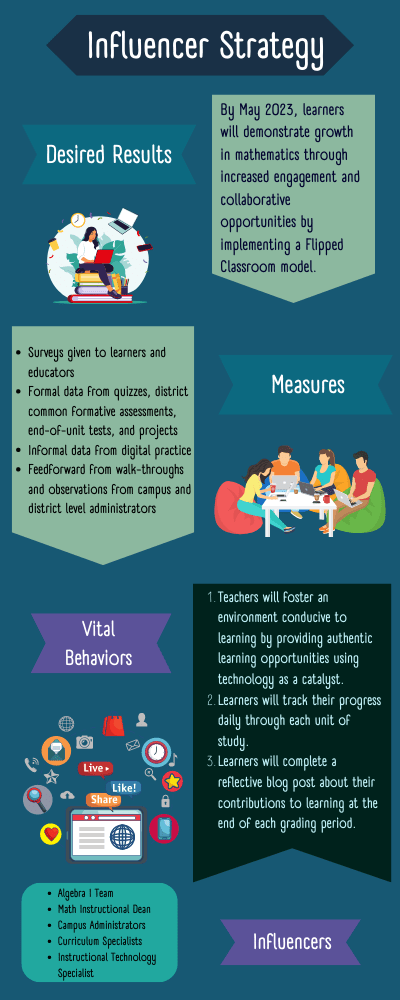
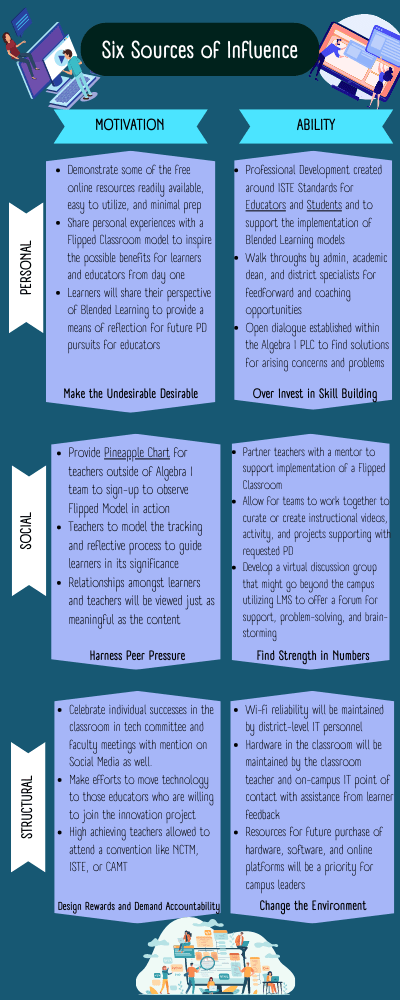
Grenny et al. (2013) claim that one can influence enduring change by employing just three keys to success. The changes the authors refer to are not equivalent to changing parts in machinery for more productivity or re-wording a satisfactory survey for client retention. Human behavior is what we are aiming to change. Those three keys to success are focus and measures, vital behaviors, and engaging the six sources of influence (2013, pp. 13–14).
With the inspirational experiences shared and the step-by-step approach presented in the Influencer book, I have developed a strategy to move my innovation plan forward and better ensure its inevitable success for my learners (Grenny et al., 2013). The prospect of influencing educators to change is daunting, even with the guidance I have received. I have found myself trying to implement these strategies with my learners as I have learned them. I have learned over the last two years that the consequence of a bad grade does not motivate most teenage learners to participate in the learning process. While utilizing all six sources of influence creates the best scenario for change, I was curious if engaging one, like personal ability, would influence just one learner.
I strive to offer choice in my classroom to all my learners. It is more work, but it usually leads to greater engagement on their part. The feedback I received from several learners is that they appreciate the option to choose which practice they would complete. The immediate feedback from the digital practice is also helpful for them when they are struggling. My use of online resources to gamify their learning has also been well-received. Several students that will often not participate regularly have asked for more opportunities to learn using those platforms like Blooket and Quizizz. Through these experiences and conversations with my learners, I can create meaningful stories to share with my team and administration.
Small opportunities like this offer huge gains in influencing change. When learning change, we must convince the heart and mind (Kotter, 2011). Through relationships and trust, we can start influencing our vital behaviors. Reflecting on my Influencer Strategy, I have made a point to return to my “Why.” Interpersonal skills have always been a strength for me. Without that ability, I would not be where I am today as an educator. It is not only my relationships within my classroom that are important, but beyond those walls with my colleagues and leaders on campus. I am also striving to include those stakeholders outside my direct learning community. District-level support will help grow this change beyond my campus. My goal is to influence change amongst my fellow educators and our learners. As a PLC, we, the Algebra I team, always plan with the desired results in mind. With a well-drafted plan, using the Influencer Model that engages the six sources of influence, we will experience the full potential of our influence to bring about change that will sustain us as long as we remain focused on the desired results.
References
Dr. John Kotter. (2011, March 23). John Kotter – The Heart of Change [Video]. YouTube. https://www.youtube.com/watch?v=1NKti9MyAAw
Gracey, L. (2021, February 26). Pineapple charts: Learning from your peers. TCEA Technotes. https://blog.tcea.org/pineapple-charts/
Grenny, J., Patterson, K., Maxfield, D., McMillan, R., & Switzler, A. (2013). Influencer: The New Science of Leading Change, Second Edition (2nd ed.). McGraw Hill.
ISTE. (n.d.-a). https://www.iste.org/standards/iste-standards-for-teachers
ISTE. (n.d.-b). https://www.iste.org/standards/iste-standards-for-students
21st century skills ability art autonomy blended learning change choice board collaboration connections COVA creativity discussion edtech education ePortfolio facebook failure feedback feedforward flipped classroom Google growth mindset innovative iste learning learning menu mistakes nctm networking philosophy PLC pln possibilities proactive professional progressive reflection secondary mathematics Slides success technology urgency workforce writing yet
 Valary's Vision of a Modern Secondary Mathematics Classroom