
When I have shared the experiences of creating my ePortfolio with my learners, the comments and reactions are comical. One young man asked me, “Why do you have to have a Blog? Writing about math? Gross!” My response was laughter because this young man was partly kidding. I explained a little bit about what I am trying to accomplish. I spared them the details that I could have provided about CSLE+COVA (Harapnuik et al., 2018). I will admit to getting a little excited when I have the opportunity to talk about the ADL program. If I had the chance, I likely would have not been able to get to the learning target for that day’s lesson. I made my students aware that they are part of my evidence and a direct reflection on my mastery of the concepts I am tasked to master throughout the ADL Program. I saw a few smiles and heard a few sarcastic responses of “Good luck with that, Mrs. Patterson!” All of these are really said in jest. I have great learners that I teach me something on an almost daily basis. I am fortunate to get to help them realize their full potential as learners.
While my classroom and the learning that occurs there is a piece of my ADL puzzle, one of the other pieces is my ePortfolio. Through my research and development of my Innovation Project and further exploration of the power of one’s Mindset, I have already experienced measurable progress with most of my learners. The response from many learners is the success they find with Flipped Classroom hybrid model I have adopted. Blended learning is defined as the use of online resources, electronic media, and face-to-face instruction for students’ means of learning. Under the umbrella of blended learning, the flipped classroom is a strategy that has the learners watch a curated or instructor-created instructional video at home. This allows for time in the classroom to be utilized for group discussions or activities or the practice that would have been assigned in a traditional classroom (Horn et al., 2015). My team’s approach is a version of this due to the demographic of learners that we have in our classrooms. We have planned for all learning to happen in a class period with teacher support. With this adjustment to the Flipped Classroom model, I am afforded precious time in a class period to help individuals or a small group. This is a teacher’s dream.
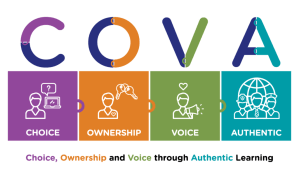
During this second term of my coursework, as I focused on creating my ePortfolio, I found the time to continue to ponder and develop some strategies and approaches to try with my learners. With all that I have learned about creating significant learning environments that give my students choice, ownership, and voice through authentic learning, one can only reflect on her practices (Harapnuik et al., 2018). Some ideas have been in the back of my mind for several weeks, but I made some realizations that I posted about in my Blog. Engagement and collaboration, two ongoing challenges, are addressed.
As we enter into the second grading period of the school year and I begin my next course, I will remain vigilant in my reflecting and analyzing the progress in my classroom. It is imperative for all involved to stay focused on the goal and to be flexible in our approach when seeking to attain it. I must also keep lines of communication open with my Learning Communities. It is through these contributions to my learning and that of others that will result in reaching our full potential as learners. My ePortfolio will serve as a manifestation of that journey. We use an ePortfolio because creating something leads us to deeper and more meaningful connections in our learning. Reflection is also an important component of learning (Harapnuik, 2021). I am eager to open more doors in hopes of learning how to be a better educator for my learners.

References
Harapnuik, D. (2021, May). Why Use an ePortfolio. It’s About Learning. Retrieved October 11, 2022, from https://www.harapnuik.org/?page_id=6063
Harapnuik, D., Thibodeaux, T., & Cummings, C. (2018, January). COVA (0.9) [EBook]. Creative Commons License. https://www.harapnuik.org/?page_id=7291
Horn, M. B., Staker, H., & Christensen, C. M. (2015). Blended: Using Disruptive Innovation to Improve Schools (1st ed.). Jossey-Bass.


 Valary's Vision of a Modern Secondary Mathematics Classroom