

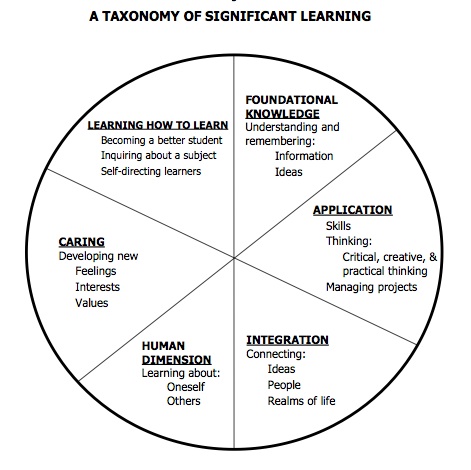
In my last assignment, I used Fink’s 3 Column Table to design and plan a unit of study for my learners (2003). The 3 Column Table gives an overview of learning like that to a zoomed out view of a map. We see the starting location, (the situational factors), popular points of interest along the way (learning outcomes), and our final destination (BHAG). This tool is a great jumping-off point when designing a course or a unit of study. With the guidance of a Taxonomy of Significant Learning, we can devise opportunities for learners to make deep connections through different kinds of learning (Fink, 2003). The big ideas in the unit or course are organized in a way that is easy to determine where we want our learners to go with the content and their understanding.
A broad look is useful to a point. We also need to zoom in to see those popular sites along our journey. We need to look more closely at possible misconceptions and ideas that might not be relevant to the success of a learning outcome. This is where we look to Wiggins and McTighe’s Understanding by Design, UbD, and the provided 1-Page Design Template (2002, p. 22) . As I reflect on the time I spent in my undergraduate Education program designing courses or units of study, I was not able to recall any significant learning that I experienced in this area. Most educators are given utopian views of the classroom and planning. We are ill-equipped to design courses that lead to developing significant learning environments. I was first introduced to UbD in my time in Plano ISD in Plano, TX, a suburb of Dallas, TX. Through the PLC process, we took the backwards design approach in all our planning and creating learning experiences.
The beginning of the UbD process always starts with the final destination, what do we want our learners to learn? What does that learning look like? This is Stage 1 of the UbD template (Wiggins & McTighe, 2006). The Established Goals will lead the way for the creation of the unit. For my unit, the goals are directly from state-issued skills called TEKS (Texas Essential Knowledge and Skills). It is using the TEKS that we determine our Understandings and Essential Questions. The Understandings and Essential Questions will steer the way to what knowledge and skills the learners will attain through the Learning Experiences. Before the activities created in Stage 3, we have to plan our Assessment Evidence in Stage 2. The assessment will be what will be the data we use to determine levels of understanding and mastery. We use the assessments to drive the instructional plan and learning activities. In the end, we find ourselves at the beginning of the learning process. By working backwards, our path is clear and the destination final.
A broad look is useful. We must also zoom in to see those popular sites along our journey. We need to look more closely at possible misconceptions and ideas that might not be relevant to the success of a learning outcome. This is where we look to Wiggins and McTighe’s Understanding by Design, UbD, and the provided 1-Page Design Template (2002, p. 22) . As I reflect on the time I spent in my undergraduate Education program designing courses or units of study, I cannot recall any significant learning I experienced in this area. Most educators are given utopian views of the classroom and planning. We are ill-equipped to design courses that lead to developing significant learning environments. I was first introduced to UbD during my time in Plano ISD in Plano, TX, a suburb of Dallas, TX. Through the PLC process, we took the backward design approach in planning and creating learning experiences.
The beginning of the UbD process always starts with the final destination, what do we want our learners to learn? What does that learning look like? This is Stage 1 of the UbD template (Wiggins & McTighe, 2006). The Established Goals will lead the way for the creation of the unit. For my unit, the goals are directly from state-issued skills called TEKS (Texas Essential Knowledge and Skills). It is using the TEKS that we determine our Understandings and Essential Questions. The Understandings and Essential Questions will steer the way to what knowledge and skills the learners will attain through the Learning Experiences. Before the activities are created in Stage 3, we must plan our Assessment Evidence in Stage 2. The assessment will be the data we use to determine levels of understanding and mastery. We use the assessments to drive the instructional plan and learning activities. Ultimately, we find ourselves at the beginning of the learning process. By working backward, our path is clear, and the destination is final.

When considering the design of instruction and learning experiences, Wiggins And McTighe (2006) propose that our desired results drive us. Wiggins and McTighe use the acronym WHERETO to guide the design of learning activities. Does the instruction and learning activity satisfy at least one of the following?
- WHERE will the unit take the learner? WHAT is expected for the learner to be able to recall?
- HOOK and HOLD the learners curiosity?
- EQUIP learners to best EXPERIENCE the important ideas and EXPLORE the content?
- REVISE and RETHINK the understanding and work throughout the learning experiences?
- EVALUATE their own products and its implications on the mastery of the content?
- TAILOR to learners of differing needs; meet them where they are?
- ORGANIZE activities to maximize engagement and effective learning?
When thinking about my future tasks of course and unit design, I see benefit and value in both approaches to this endeavor. Considering the situational factors and Taxonomy of Significant Learning, the 3 Column Table is a wide view of the learning journey from beginning to end of a course or unit (Fink, 2003). It also provides an excellent starting point for the UbD process (Wiggins & McTighe, 2006). We can tie our learning outcomes to goals, understandings, and essential questions. As we narrow our focus, we can decide what evidence we seek as our assessment piece of learning. I appreciate that the evidence we look for is not just a unit test or quiz. We look to utilize formal activities, like, performance tasks, tests, and quizzes, and informal products, such as self-evaluations and casual conversations within a class setting. It makes for a chance to think about what learning truly looks like as an interactive experience.
I have used other methods of gathering evidence of learning to engage even my most reluctant learners. Through implementing my Innovation Plan, I have been afforded more chances to converse with my learners one-on-one. Through these discussions, I have been able to assess present levels of learning among my learners. I also take time to discuss what implications of using the technology resources available to find the answers. How does this affect what learning looks like? Those conversations reveal a learner’s understanding is only at the surface level. Most do not see the problem with cheating. They know that it may result in a failing grade on a quiz or test. While they can reattempt an unsuccessful assessment, I have found that few will make a concerted effort to learn the content before the second attempt. I will move forward in my design of future units of study and be purposeful and intentional in engaging and motivating my learners in meaningful and authentic learning. I continue to be driven by my desire to inspire my learners with the value to be gained through education and learning.

References
Bowen, R. S. (2017). UbD Framework. Vanderbilt University Center for Teaching. Retrieved February 26, 2023 from https://cft.vanderbilt.edu/understanding-by-design/.
Fink, L. D., Ph.D. (2003). A self-directed guide to designing courses for significant learning. Retrieved from https://luonline.blackboard.com/ultra/courses/_194621_1/outline/edit/document/_7704794_1?courseId=_194621_1&view=content
Resources. (2023). Lead4ward. Retrieved February 26, 2023, from https://lead4ward.com/resources/
Wiggins, G. P., & McTighe, J. (2006). Understanding by Design. Pearson Education, Incorporated.
21st century skills ability art autonomy blended learning change choice board collaboration connections COVA creativity discussion edtech education ePortfolio facebook failure feedback feedforward flipped classroom Google growth mindset innovative iste learning learning menu mistakes nctm networking philosophy PLC pln possibilities proactive professional progressive reflection secondary mathematics Slides success technology urgency workforce writing yet

 Valary's Vision of a Modern Secondary Mathematics Classroom