
As a little girl, I remember my sister and I lining up our dolls and stuffed animals in rows in front of our art easel. Pretending we were teachers was one of our favorite activities as young girls. Playing make-believe was almost all we would do when we played. We would play store with an old calculator my dad gave us. We would rake the leaves in our front yard in the layout of a “house” with multiple rooms. We imagined them being mansions! Those are memories I cherish. As I read A New Culture of Learning: Cultivating the Imagination for a World of Constant Change, I consider the connection between the imagination and play of a child to the learning that happens beyond childhood. It leads me to wonder also about how I can influence the future generations who will play school, to change the imaginary environment from the “sit and get” to the collaborative experiences of a collective (Thomas & Brown, 2011, pp. 50-54).

As an educator, I know firsthand that our public education system is fatally flawed. Reform is the word one hears in the media, community discussion forums, and teacher workrooms. However, it is more complex than just a few changes or laws that need to be passed. Education needs a revolution (TED, 2010). Our approach to teaching and learning in a schoolhouse needs to be reconstructed. That transformation has to begin within the walls of the classroom. Thomas & Brown challenge the notion of a traditional classroom by stressing the importance of imagination and play through many different learning approaches, including peer-to-peer learning, questioning, and inquiry (2011). By creating significant learning environments, I will allow my learners to experiment and question.

At the beginning of the school year, I set out to implement my innovation project. Armed with research from my literature review, my team and I aimed to provide a blended learning approach to the curriculum. We developed a plan that modified a Flipped Classroom model that would be best for our learners. Stations are incorporated for further intervention and enrichment opportunities. Learners are given a layout of the lessons with firm deadlines for assessments. The choice in how they tackle the concepts is theirs to make. Learners are given access to lesson videos in and out of the classroom. Different options are available to practice the concepts, including low and high-tech choices.
The task of igniting passion and inquiry and stimulating imagination within constraints is a task that is more complex for a teacher of a state-tested subject (TEDx Talks, 2012). My biggest obstacle every school year is to guide my learners to find their full potential as a learner. My students enter my classroom with low self-confidence and fixed mindsets. Boaler argues that there is no such thing as a “math person” and that we can all learn math (2022). More simply, everyone learns different things when presented with the same concepts (Thomas & Brown, 2011). As teachers, we believe the notion that we all learn in different ways. Everyone has a learning style. The truth is that we all learn different things from the same lesson. This fact of learning is powerful. Moreover, it supports collective learning (Thomas & Brown, 2011).
Collaboration, i.e., group work, has a bad reputation among learners. Anytime they are tasked with working in a group, they resist. It should never be a forced occurrence. Play is a strategy that can illicit working as a group in a less intimidating way. We look at how many of our learners already collaborate daily during an online game. Using platforms like Discord and Twitch, they come together naturally as a collective. Thomas & Brown defines a collective as “a collection of people, skills, and talent that produces a result greater than the sum of its parts” (2011, p. 52). Those in a collective are so to learn, unlike a community, where people are there to belong (Thomas & Brown, 2011).
Play in a secondary math classroom looks different than the kitchen and dress-up centers that Kindergarten teachers have for their learners. Play is the gamification of practice, using online resources like Blooket, Quizizz, and Kahoot. There low tech approaches to gamify a lesson, too, such as Trash-ket Ball and Whiteboard Races. These activities can foster a culture of a collective. My expectations is for my learners to look to the resources they have to answer questions and find errors in understanding. We use the “Ask three, then me” mantra. By requiring struggle and inquiry, the acquired solutions will result in deepened meaning for the learners. We will nurture them to an appreciation of failure and the opportunity is affords in their knowledge.
Struggle and inquiry require the roles of learners and teachers need to be redefined. Learners need autonomy within constraints drawn by the educator. The role of the teacher is at issue. Teachers should focus on coaching and mentoring rather than delivering the content to the learners (Thomas & Brown, 2011). Learners must also take ownership and control of their education to find their potential (Dwayne Harapnuik, 2015). It is on them to take this responsibility to heart. Accountability to one’s self and the collective being cultivated within a classroom is a large part of the learners’ roles within the learning experience. Educators must relinquish control to the learners. The learners have to do the learning. We can can only guide and encourage them.
The physical layout of the classroom must also be considered. This is likely the most obvious piece of creating significant learning environments. However, it should not be bounded by the walls of any particular classroom (Thomas & Brown, 2011). The learning environment should inspire learners to work together to question and search for the knowledge to master the content. The latest trends in the physical setting are flexible seating. These are tables, couches, bean bags, and rugs with ambient lighting and music to help with focus. This area takes work for a teacher to overcome due to financial obstacles. One must be innovative in using students’ desks to achieve what one might with options like tables with tools and other comfortable furniture. One task I challenged my learners with was continuing discussions from the topics learned in class utilizing Microsoft Teams. This allows for a virtual study group that I can monitor. While I have tried to influence conversation, the learners have the reigns. I encourage them to use it as another resource to go to when they are confused. It is just another resource they have to find solutions and answers.
Apathy has grown almost exponentially amongst our high school populations these last few years. Most are even reluctant to pick up a pencil. The culture of my classroom is my most valuable tool in combatting the hesitation to participate in learning. We must create a space to do that if we want learners to find ownership and voice in the education process. Relationships are imperative to learner success and are established on day one. Knowing more about my learners than how well they have mastered a particular standard is much more potent in ensuring their educational success. I strive for my relationships to impact their learning beyond my classroom. I am not naïve that the apathy goes beyond math class. All educators, even those that teach electives, need help to influence our learners on the importance of their learning. Gamification of the monotonous practice one must do in a math class has helped in this area. Teenagers like competition. A visual scoreboard can have a powerful influence on one’s motivation to participate, another obstacle I must tackle daily (McChesney et al., 2022). It is a simple online game that can trigger a question in a learner, leading to opportunities to deepen their understanding. It can also lead to learners working together to figure out a problem. These are the moments I treasure. It makes all the work I tirelessly do for my students much more rewarding.
Challenges to creating significant learning environments exist beyond the walls of the classroom. Convincing colleagues, administrators, and district specialists of the effectiveness of a new approach to learning can be an uphill battle for some. As for my experiences, my team has met with little to no opposition. Leadership, campus, and district level, have been supportive and encouraging. They share the idea that we must evolve for our learners to grow and learn in this constantly changing digital society. I reflect on some feedback I have received from a few from the community. It is part of our duty as educators to share why we have elected to use this model with the parents of our learners. Their perspectives were not positive, but I politely listened and agreed to disagree, knowing that my intentions were only for the success of my learners. Reflection is crucial in maintaining a learning environment that will foster and grow with my learners. Reflection comes through work within the PLC and campus leaders. By remaining proactive, we can maintain the flexibility for our learners as the grow and master the content. Flexibility is a superpower of most teachers.
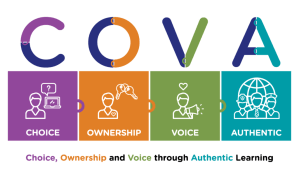
By embracing an innovative approach to learning, we can foster learning environments that will inspire our students to question their learning and lead to inquiry. Like a Flipped Classroom, a blended learning model will stimulate autonomy and choice. Opportunities for peer-to-peer learning will build up learner success and lead to finding one’s voice and ownership. By creating significant learning environments that afford experiences with choice, ownership, and voice through authentic learning (CSLE + COVA), my learners will make meaningful and deep connections in their learning (Harapunik et al., 2018). I wish those connections could lead to a life filled with learning organically. This new culture of learning will also impact future generations and lead to a more significant revolution beyond my high school math classroom. Power is in knowledge, and I want to inspire others to see value in that knowledge even when others have blinded them.
References
A New Culture of Learning Book Cover Image. (2011). amazon.com. https://www.amazon.com/New-Culture-Learning-Cultivating-Imagination/dp/1456458884
Boaler, J. (2022). Mathematical Mindsets: Unleashing Students’ Potential through Creative Mathematics, Inspiring Messages and Innovative Teaching. Wiley.
Dwayne Harapnuik. (2015, August 15). EDLD 5313 Module 1 [Video]. YouTube. https://www.youtube.com/watch?v=DTl_WLSe9Ok
Harapnuik, D., Thibodeaux, T., & Cummings, C. (2018). COVA (0.9) [EBook]. Creative Commons License. https://www.harapnuik.org/?page_id=7291
McChesney, C., Covey, S., Huling, J., Thele, S., & Walker, B. (2022). The 4 Disciplines of Execution: Revised and Updated: Achieving Your Wildly Important Goals. Simon & Schuster.
TED. (2010, May 24). Bring on the learning revolution! | Sir Ken Robinson [Video]. YouTube. https://www.youtube.com/watch?v=r9LelXa3U_I
TEDx Talks. (2012, September 12). A New Culture of Learning, Douglas Thomas at TEDxUFM [Video]. YouTube. https://www.youtube.com/watch?v=lM80GXlyX0U&feature=youtu.be
Thomas, D., & Brown, J. S. (2011). A New Culture of Learning: Cultivating the Imagination for a World of Constant Change. Van Haren Publishing.
21st century skills ability art autonomy blended learning change choice board collaboration connections COVA creativity discussion edtech education ePortfolio facebook failure feedback feedforward flipped classroom Google growth mindset innovative iste learning learning menu mistakes nctm networking philosophy PLC pln possibilities proactive professional progressive reflection secondary mathematics Slides success technology urgency workforce writing yet



 Valary's Vision of a Modern Secondary Mathematics Classroom