

In this my first assignment in Online Course Development (EDLD 5318), I have been tasked to design a course that will be presented to my colleagues. I will address why I have chosen this particular content. I will discuss what learning activities and the outcomes that I hope to see in my learners. Finally, I will look at how we will assess the learning that resulted from the course.
What are your subject, level of instruction, and intended audience?
The course that I am creating is to facilitate a professional learning experience for my colleagues that teach secondary math courses. I plan to create a learning opportunity to guide my colleagues in creating and implementing a blended learning (BL) environment in their classrooms. While this is my initial audience, I aim to offer this training to those outside my content area in the near future with the guidance and assistance of my district specialists. Ultimately, I would love to see this experience become a semi-annual option for educators in my district.
What are the key institutional documents (i.e. syllabus, outline, accreditation standards, etc.) that will influence your design process?
It has become apparent that districts have an obligation to provide reliable access to technology in and out of the classroom. In order to fulfill this commitment, my district applied for a grant through the Emergency Connectiviity Fund (ECF) offered by the Federal Communications Commission. Through the ECF, the FCC has offered over $7 billion dollars in funds for schools and libraries to use in the acquisition of tools and services for remote learning. With the award of these monies, my district procured Chromebooks for every learner. This is an opportunity for my entire community to make necessary changes in our approach to learning for the betterment of our community, youth and adults alike.
While learners will be free to choose the BL approach, I will provide resources and standards at the core of the BL pedagogy. The following resources will provide guidance for learner outcomes throughout their participation in my course: The focus on these standards is due to our obligation to provide meaningful and relevant learning opportunities for the students in our classrooms. By participating in professional development like this one, I feel I am doing my part to help my colleagues grow and develop best practices in the classroom.
- ISTE: https://www.iste.org/standards/iste-standards-for-teachers
- Focus will be on 2.1 Learner and 2.5 Designer
- Blended Learning Universe
Because the research in this area of education is constantly evolving, I anticipate my development of the learning activities and means of assessment for this course will do so too.
Are you using competency-based education (CBE) or outcome-based education (OBE)? Why?
I am using outcome-based education. This approach allows learners to navigate the learning opportunities with fewer restrictions. My goal is to drive my learners to deeper connections with the BL models and how it can result in more growth among their own learners than the traditional lecture-based instructional model. With the use of Learner Outcomes, self-assessment will be easier and more transparent. This will move my role into more of a mentor or coach than a teacher. I intend to learn right alongside my coworkers through this learning journey.
What design approach have you chosen? Why?
I have chosen to utilize the ADDIE model of instructional design as it fits the progression of the modules that I have created for my course.
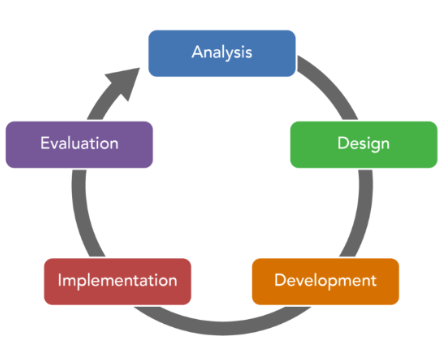
A – Analysis: In this first phase of learning, the needs and capabilities of learners is established. A pre-assessment and introduction to BL will be given to the educators.
D – Design: Learners will work with Mentors to begin design of their own BL approach for their learners (Bloom’s Taxonomy)
D – Development: Collaboration and Peer review will aid in the development of learner outcomes within each of the blended learning models to better prepare for the next phase.
I – Implementation: The BL models will be implemented in the classrooms with guidnace and support of mentors, district specialists, campus administration, and myself. Observations will be pivotal for the final evaluation of learning.
E – Evaluate: For the final module, partipcates with reflect and self-assess their learning of the content presented in this PL experience.
How will you balance assessment Of/For/As learning? Are you moving your learners into deeper learning? If not, why not? Who controls the learning?
I will provide opportunities for frequent feedforward from myself and their peers for each participant in my PD. Reflection on the learning will also be important for those deeper connections to be made and reinforced. This will happen through collaboration opportunities and mentor/mentee conferences. The chance for the learners to participate in online discussions will also serve as a formative assessment tool for me to gauge the levels of understanding. Collaboration through group activities, mentorships, and discussions (face2face or online) will foster a student-driven learning environment. Learners must find they have choice, ownership, and voice through authentic learning (COVA).
References
CSLE2COVA. (2018, June 19). Outcome-based Education vs Competency-based Education [Video]. YouTube. https://www.youtube.com/watch?v=ctEqxCr7ZUg
Emergency Connectivity Fund. (n.d.). Federal Communications Commission. https://www.fcc.gov/emergency-connectivity-fund
ISTE. (n.d.). https://www.iste.org/standards/iste-standards-for-teachersThe
ADDIE Model | Human Resources Management. (n.d.). https://courses.lumenlearning.com/wm-humanresourcesmgmt/chapter/the-addie-model/
21st century skills ability art autonomy blended learning change choice board collaboration connections COVA creativity discussion edtech education ePortfolio facebook failure feedback feedforward flipped classroom Google growth mindset innovative iste learning learning menu mistakes nctm networking philosophy PLC pln possibilities proactive professional progressive reflection secondary mathematics Slides success technology urgency workforce writing yet
 Valary's Vision of a Modern Secondary Mathematics Classroom
One response to “Online Course Design”
[…] have been working on designing a PL opportunity to offer my math department in the fall. The learning outcome of my PL is for my learners to implement a blended learning model of their choice during a unit […]
LikeLike